


Every developer in Dubai claims an international footprint. Very few actually earn it. What separates a genuinely international real estate developer from one that simply markets itself that way? It comes down to three things: the standards they build to, the partners they choose to work with, and how deeply they understand the markets where they operate.
Dubai has become one of the most sought-after destinations for global property investment, and with that has come a flood of developers — many local, some regional, and a smaller number that are genuinely international in how they think, build, and operate. The label “international” gets used freely. It appears in brochures, pitch decks, and About pages across the industry. But when you sit down with a serious investor — whether they are allocating capital from London, Shanghai, or Nairobi — they probe past the label very quickly.
The real question is not where a developer is registered or where their offices happen to be. It is about whether their practices, relationships, and expertise actually meet the expectations of a globally mobile investor base. That is a considerably higher bar.
The Standards Question: More Than Compliance
In Dubai, the baseline for real estate development is already high. The Dubai Land Department (DLD) enforces escrow protections, RERA governs developer registration, and anti-money-laundering regulations align with FATF standards. Any legitimate developer operating in the UAE operates within this framework. That is the floor, not the ceiling.
A truly international real estate developer goes beyond local compliance. They bring international construction quality benchmarks — often drawing on engineering and design expertise from across multiple markets — and they apply them consistently. When Richmind Holdings partners with firms like HBA, Zaha Hadid Architects, and Cracknell on its real estate projects, those partnerships are not ornamental. They exist because internationally recognised design and hospitality expertise produces a product standard that a globally mobile buyer recognises and trusts.
There is something else worth noting about standards: transparency. Investors from mature property markets — the UK, Germany, France — are accustomed to clear disclosure on development timelines, cost structures, and project governance. A developer serious about the international market does not make buyers dig for this information. They offer it upfront, because they know that trust, once broken on a cross-border transaction, is nearly impossible to recover.
Every developer in Dubai claims an international footprint. Very few actually earn it. What separates a genuinely international real estate developer from one that simply markets itself that way? It comes down to three things: the standards they build to, the partners they choose to work with, and how deeply they understand the markets where they operate.
Dubai has become one of the most sought-after destinations for global property investment, and with that has come a flood of developers — many local, some regional, and a smaller number that are genuinely international in how they think, build, and operate. The label “international” gets used freely. It appears in brochures, pitch decks, and About pages across the industry. But when you sit down with a serious investor — whether they are allocating capital from London, Shanghai, or Nairobi — they probe past the label very quickly.
The real question is not where a developer is registered or where their offices happen to be. It is about whether their practices, relationships, and expertise actually meet the expectations of a globally mobile investor base. That is a considerably higher bar.
The Standards Question: More Than Compliance
In Dubai, the baseline for real estate development is already high. The Dubai Land Department (DLD) enforces escrow protections, RERA governs developer registration, and anti-money-laundering regulations align with FATF standards. Any legitimate developer operating in the UAE operates within this framework. That is the floor, not the ceiling.
A truly international real estate developer goes beyond local compliance. They bring international construction quality benchmarks — often drawing on engineering and design expertise from across multiple markets — and they apply them consistently. When Richmind Holdings partners with firms like HBA, Zaha Hadid Architects, and Cracknell on its real estate projects, those partnerships are not ornamental. They exist because internationally recognised design and hospitality expertise produces a product standard that a globally mobile buyer recognises and trusts.
There is something else worth noting about standards: transparency. Investors from mature property markets — the UK, Germany, France — are accustomed to clear disclosure on development timelines, cost structures, and project governance. A developer serious about the international market does not make buyers dig for this information. They offer it upfront, because they know that trust, once broken on a cross-border transaction, is nearly impossible to recover.
The Partners That Define You
There is an old saying in international business: you are your partners. In real estate development — where projects are multi-year commitments involving architects, contractors, asset managers, legal advisors, and sales channels across multiple jurisdictions — this has never been more true.
For a luxury property developer in the UAE, the partner network is effectively a signal of intent. Who designs the interiors? Which hospitality operator has agreed to manage the amenity deck? What legal firm handles the cross-border transactional structures? What sales network reaches buyers in Europe, Asia, and the GCC simultaneously?
Richmind Holdings has built its real estate vertical on precisely this foundation. Operating across nine countries — with offices in London, Hamburg, Paris, Marbella, Lisbon, Dubai, Ras Al Khaimah, Muscat, and Shanghai — the company does not simply claim an international presence. It has operating infrastructure in markets where its investors and partners actually live. When a buyer in France or a financial institution in Germany needs to conduct due diligence, there is a team locally that they can speak to, in a time zone that makes sense, with familiarity of local legal frameworks.
“Cross-border real estate investment is not just about the asset. It is about the operating infrastructure, the partner ecosystem, and the credibility that comes from actually being present in the markets you serve.”
This kind of geographic redundancy matters more than most developers acknowledge. The Dubai real estate market attracts buyers from over 180 nationalities. A developer who can speak to the concerns of an Indian NRI investor, a European family office, and a Chinese high-net-worth individual — not just in a sales deck but through real relationships and regional expertise — is operating in a fundamentally different category from one who simply lists a London address on their website.
Market Expertise: Depth, Not Just Breadth
One of the most common misunderstandings about international real estate development is equating global presence with market expertise. They are not the same. A developer can have offices in ten cities and still lack genuine understanding of the specific demand drivers, regulatory nuances, and buyer psychology that determine whether a project succeeds or fails in any single one of them.
Genuine market expertise in Dubai, for example, means understanding the distinction between freehold and leasehold, knowing which communities carry the strongest rental yield for short-let investors versus long-hold families, recognising how shifts in the Golden Visa programme affect buyer demographics, and staying close to how DLD transaction data reflects real demand rather than headline noise. It also means understanding the off-plan market — and the expectations of buyers who are committing capital before a building exists.
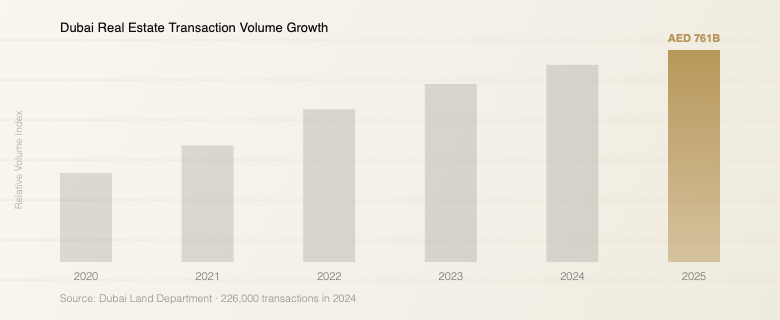
For the broader category of global property investment in Dubai, this depth of knowledge also extends to understanding how international capital flows are being shaped by macroeconomic conditions, currency movements, and geopolitical considerations that affect where wealthy individuals and family offices choose to park their wealth. Dubai is currently benefitting from a significant repositioning of wealth from Europe, South and Southeast Asia, and parts of Africa. An international developer who understands these inflows — and can speak to investors in their native context — is far better positioned than one who simply waits for inbound enquiries.
The Holding Company Advantage
There is one structural feature that genuinely separates developers like Richmind Holdings from standalone real estate businesses: the holding company model. When real estate sits within a diversified group that also operates in investment, project management, fintech, and media, the operational knowledge transfer is real and consequential.
Project management disciplines developed across industrial sectors apply directly to construction and delivery timelines. Investment governance frameworks built for institutional capital allocation apply to development finance decisions. Media and communications infrastructure means the group can shape its own narrative rather than depending entirely on third-party brokers to represent its assets.
For an investor evaluating a cross-border real estate investment, this kind of multi-sector operational credibility is reassuring. It suggests that the people making development decisions are not operating in a silo, but drawing on a broader understanding of how capital, markets, and delivery all interact.
Why Dubai Rewards Genuine Internationalism
Dubai is, in many ways, the perfect market to test whether a developer’s international credentials are real or performed. The city itself is the most international real estate market on earth by buyer diversity. It has robust institutional infrastructure through DLD and RERA, a growing ecosystem of global banks and wealth managers who carry out rigorous due diligence on the developers they recommend to clients, and an investor base sophisticated enough to tell the difference between genuine credentials and marketing spin.
Meeting real estate standards in Dubai at the international level requires more than delivery. It requires the kind of institutional credibility that takes years to build — through completed projects, through maintained partnerships, through operating presence in the markets that matter to your buyers, and through the quiet, consistent demonstration that your governance and transparency standards are not adjusted depending on which jurisdiction you happen to be selling in that quarter.
For investors doing serious due diligence in 2026, these are no longer secondary considerations. They have moved to the centre of the evaluation. And for developers who have genuinely earned their international credentials, that shift is very welcome.


